
At Cal Fund we’re at the heart of AI. BAIR (Berkeley AI Research) is an internationally renowned AI lab. OpenAI, Anthropic, and Perplexity all have origins tied to Cal. Pretty cool, right? That’s one of the things about Cal, and why Cal Fund was formed. Amazing things are always coming out of Cal and the UC system and we are here to help bring the “wisdom and learnings of the UC system to the world.” We don’t just invest in founders, we invest in the system, learn from it, act as a part of it, and take the lessons for ourselves as well.

Beautiful Berkeley
In this brief we share how we’re using AI to enable more for our fund, our investors, our founders, and the system that we so proudly support and serve.
In August our co-GP Bryce Gilleland wrote personally about building this system, in a piece on Medium: what it is like to run a fund this way, and what it frees a small team to do.
Here we focus on the operational leverage that can be gained by using this technology - and how that aligns with our mission and purpose.
One memory, many hands - here’s a visual of our fund
As a testament to Cal, we named our AI lead Bancroft. He’s the Chief of Staff, the coordinator. He’s a central brain that manages connections, processes, and flow. He doesn’t do all the work - we have a variety of agents for that - but he’s the single source we can go to for nearly anything. He serves us, we serve our LPs and founders, and they serve the broader community. It’s a system built with intention and purpose.
Why “Bancroft”?
Every team member needs a name, and “chief of staff” was a mouthful. When we needed to name the agent at the center of our system, we looked across campus. The Bancroft Library at UC Berkeley is the place that holds everything: the archives, the history, the institutional memory. That is exactly the job, so the name stuck. Its sibling, the agent that answers our investors’ questions, is called Sather, after Sather Gate, Berkeley’s front door to the world. One holds the memory, the other is the threshold, and the names keep straight which is which.
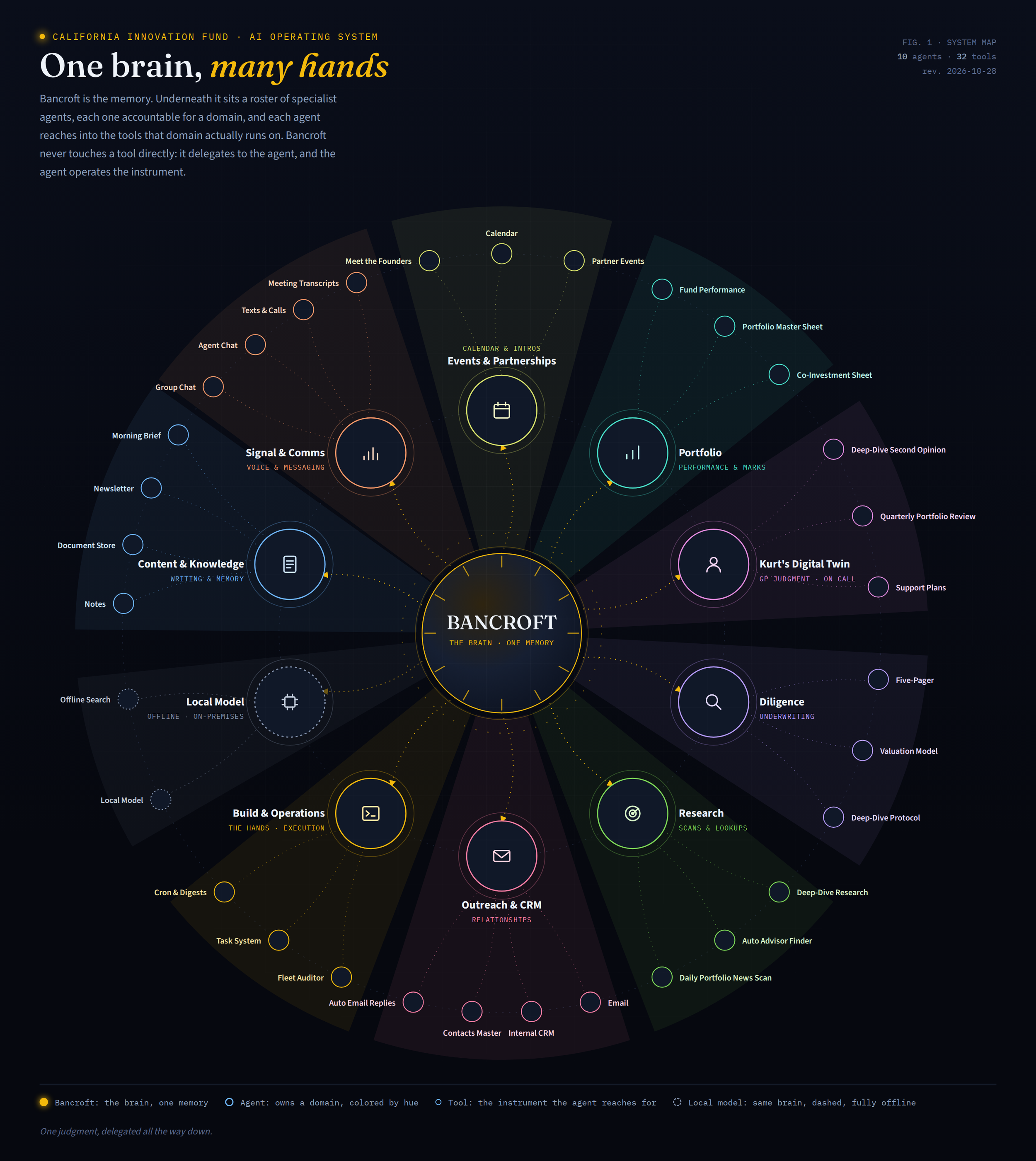
Fig. 1. The system map. One memory at the center, ten specialist agents, 32 tools. Bancroft delegates; the agent operates the instrument.
Bancroft holds the fund's memory: every contact, every meeting, every commitment. It has access to our pipeline and portfolio database and reads and writes from them which ensures we track and log everything - in a better and more systematic way than we could ever have done before.
Bancroft also never touches a tool directly. It delegates to specialist agents, each accountable for one domain, and each of those agents operates the instruments that domain runs on: the calendar, the CRM, the portfolio sheet, the valuation model, the news scan, etc.
Three rules sit underneath all of it. A person releases everything that goes to a founder or an investor; the system drafts or helps draft many of these, and a partner sends. Investor-sensitive data is walled off, inaccessible to all but one agent who only responds to a human, and fund data is organized in a prescriptive and deterministic manner. And every action leaves a record, which is what makes this article possible - and how we ensure agents are acting appropriately. We also have a weekly review where each agent recommends improvements for themselves.
Similar to De La Salle and their weekly goal setting and weekly self reviews - our systems do the same. What went well, what can we improve on, and what mistakes did we make? Now how do we be a better version of ourselves? We work together to be the best we can be.
In October we added a fourth layer: a short written statement of the fund's purpose and priorities, which every agent reads when it starts.
It all ties back to purpose and intention.
Our mission is to take the knowledge and expertise of the University of California out of its labs and classrooms and apply it to the real world.
The schedule are the admin tasks that no longer take our brain space
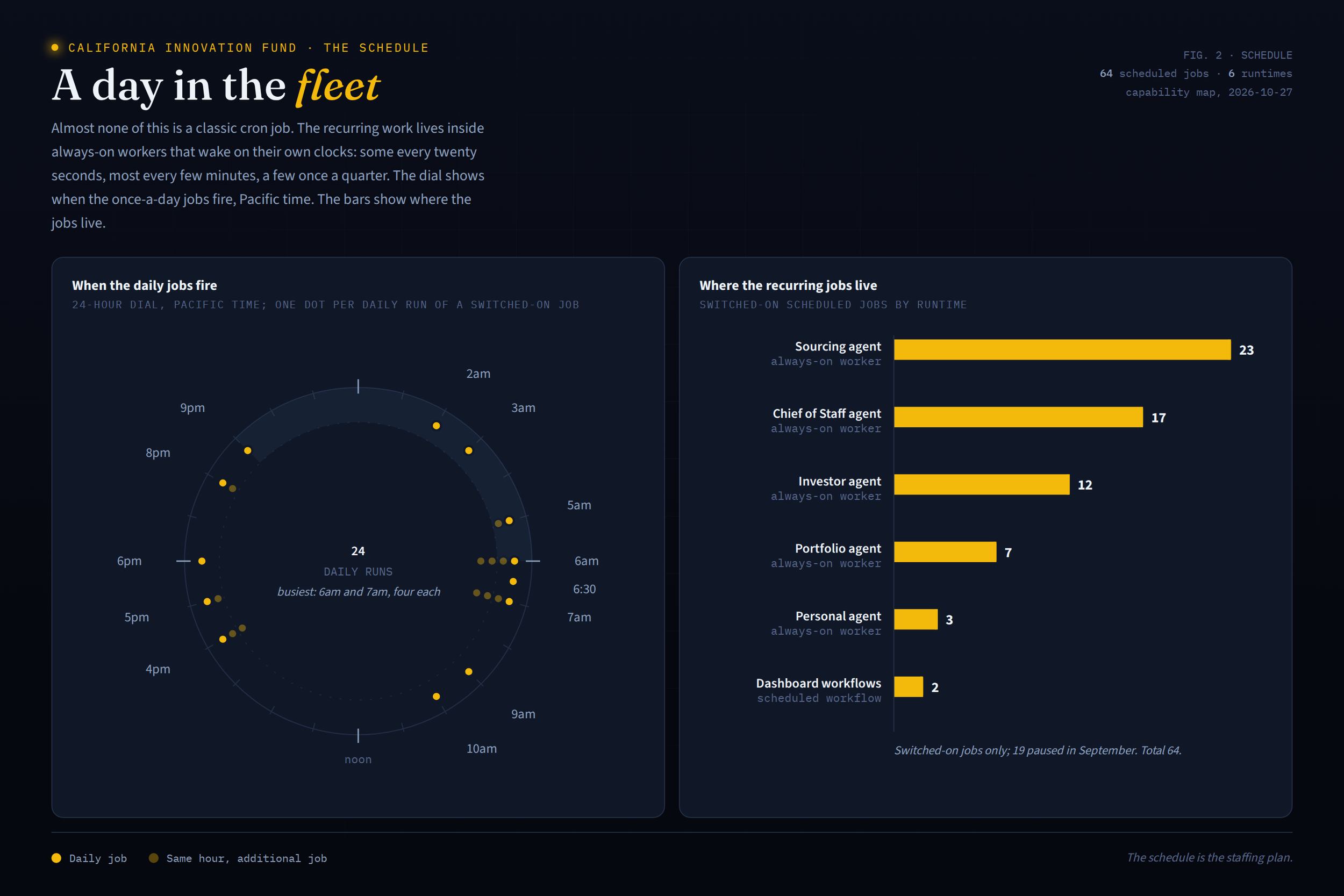
Fig. 2. When the daily jobs fire, Pacific time, and where the 64 switched-on scheduled jobs live. Capability map, October 27, 2026.
Today 64 scheduled jobs are switched on across our five directed agents and the dashboard. Almost none are classic cron entries. They live inside always-on workers that wake on their own clocks: a publish check every twenty seconds, an inbox scan every three minutes, a news sweep every morning, a mark review every Monday, a quarter close four times a year.
The number went down on purpose. In late September we switched off nineteen jobs whose season had passed. A job that runs without a reader or purpose is not leverage; it is noise with a bill attached. This is also a common problem we see with many builds - build because it’s easy, not for true purpose.
Twenty-two jobs run at a fixed hour each day. The busiest hours are 6am and 7am Pacific, four jobs each: the morning brief, the daily standup, the portfolio publish, the weekly metrics collector, the news sweep, the meeting-notes sync, the day's meeting preparation and the expense scan. By the time a partner opens a laptop, we're already aware of the day's tasks and any important alerts.
What changed for founders
At the end of the day our goal is to support founders. They are the ones driving the change that will change the world. They are solving hard problems day after day and if we can help them, that’s amazing. We are helping to positively change the world.
The relationship graph holds more than 7,100 people, more than 700 advisors and operators profiled by sector, stage and function, and, as of this month, more than 91,000 captured interactions across email, meetings, calls and texts. When a portfolio company needs a regulatory reviewer or a first enterprise customer, the system finds the shortest real path and drafts the introduction. A partner reads it and sends it. Go to market, fundraising, scientific support, labs, real estate, you name it. We have leads that we have relationships with that our system searches and flags to optimize our support.
The support that matters most to an early founder is usually a person: the advisor who has been through the same regulatory path, or the investor who knows the space. When a company names a need, matching starts from people we actually know, ranked by sector, stage and function, rather than from a search engine. When a portfolio company raises, we build the target list with them: venture firms whose thesis fits, and next to each one, who in our network can make a warm introduction. For one company's seed round that list was shared with the company's other investors, so everyone around the table worked the same introductions instead of duplicating them.
Coordination is easier, faster, and aligned.
As busy people we often have so many tasks, conversations, meetings, etc that lead to asks. On days with a dozen meetings, this becomes problematic and leads to promises delayed or tasks missed. Tasks promised but forgotten or slipped to lower priority. This doesn’t happen anymore. This is where integration is key. Granola captures everything, when permitted, and our system reads it and monitors tasks. For many semi-routine tasks our agents have deterministic workflows, messages that match our own style so less formatting is needed, and the ability to make several leaps of action without any guidance.
Now working with my agents is like working with a highly trained team. It reminds me of my prior job where I had a multi-layered, 13-man team. Though, and very critically, it doesn’t replace the human connection we all need in our work. I don’t want to let this point be just a single line. AI is great, it’s very helpful, it's incredibly powerful… but the core of its benefit is to connect us in a better, faster, and smarter way. Our investor introductions, advisor introductions, science reviews, etc. It connects us with experts who are even smarter in their respective area.
AI is an enabler, not a replacement.
Founders also get a room. Since July, portfolio founders have presented directly to our investors and network in a monthly Meet the Founders session, with a recording and recap sent afterward; the first recap went to about 240 people. For a seed-stage founder that is an hour in front of potential follow-on investors, customers and advisors that would otherwise take dozens of separate meetings to assemble.
Again, it allows us to more easily connect people with each other, bring experts and founders together. Each session has had positive ripples and that’s the goal.
The same machinery watches. Since July the portfolio news scan has caught 268 items, each proposed to a person as a possible support play: a congratulations, a co-investor push, an advisor match. Founder updates that arrive by email are harvested into the company record automatically, including the corrections founders make to our own memos, so the version of a company we carry is the founder's current version, verified, rather than the one we wrote months ago and forgot to update.
It also works in a room.
On October 13 we co-hosted the Berkeley Deep Tech Innovation Matchmaking Summit with the Deep Tech Innovation Lab and Berkeley Lab: about 130 people, 25 startups and 43 investors. Many of these invitation lists came out of the same relationship graph. And it’s variable. Change the types of investments, you change the room. It works with us to do that.
We also share what we build. One of the great parts is finding the other AI builders - it’s a community. This article is one example; we have partners who take part in weekly sessions where founders and investors compare notes on building with AI.
What it means for our investors
Investors in a small fund usually get a quarterly PDF. Ours get more, and none of it depends on someone finding the time.
Our investors see the portfolio in more depth than the fund-administration tools can even offer: every position, its value under several marking methods, and the reasoning behind each mark, refreshed at least monthly, or whenever any significant updates come in - good or bad. A partner approves every number change before it appears. This is the kind of transparency I always wanted as an investor. We can now deliver this easily to our investors.
Co-investment opportunities, from the portfolio and the pipeline, are shared on one page that is kept current: what each company does, the round, and where our diligence stands, so anyone considering a co-investment works from the same facts we do and can easily request updates or further diligence. This is no longer a headache of cramming new work into an already too-busy day; it’s a simple request to Bancroft.
Questions from investors, by email or in our investor group chat, are answered from published fund data and drafted for a person to review.
Investors meet founders directly, at our events and in the monthly Meet the Founders sessions, and some go on to help as advisors or with strategy when it fits.
The point is not polish. It is that what we learn about a company reaches the people who backed it on the day we learn it.
How deep a review goes, and the case against
When a company reaches a deep dive we kick into motion our full review, more complex than it was before. This means we save dozens of hours of research while improving quality. It delivers a broad deep dive, a valuation methodology backed with verified and traceable data, and a counterfactual that argues against our own report. We do our own human review of this and then run an advisor and connector route to help answer our deeper questions and bring in expert external reviewers. By our estimation we get tens of hours of research and analysis, connections we otherwise wouldn’t have made, and greater confidence all for less cost and time. Significantly less cost and time, orders of magnitude could be an understatement here.
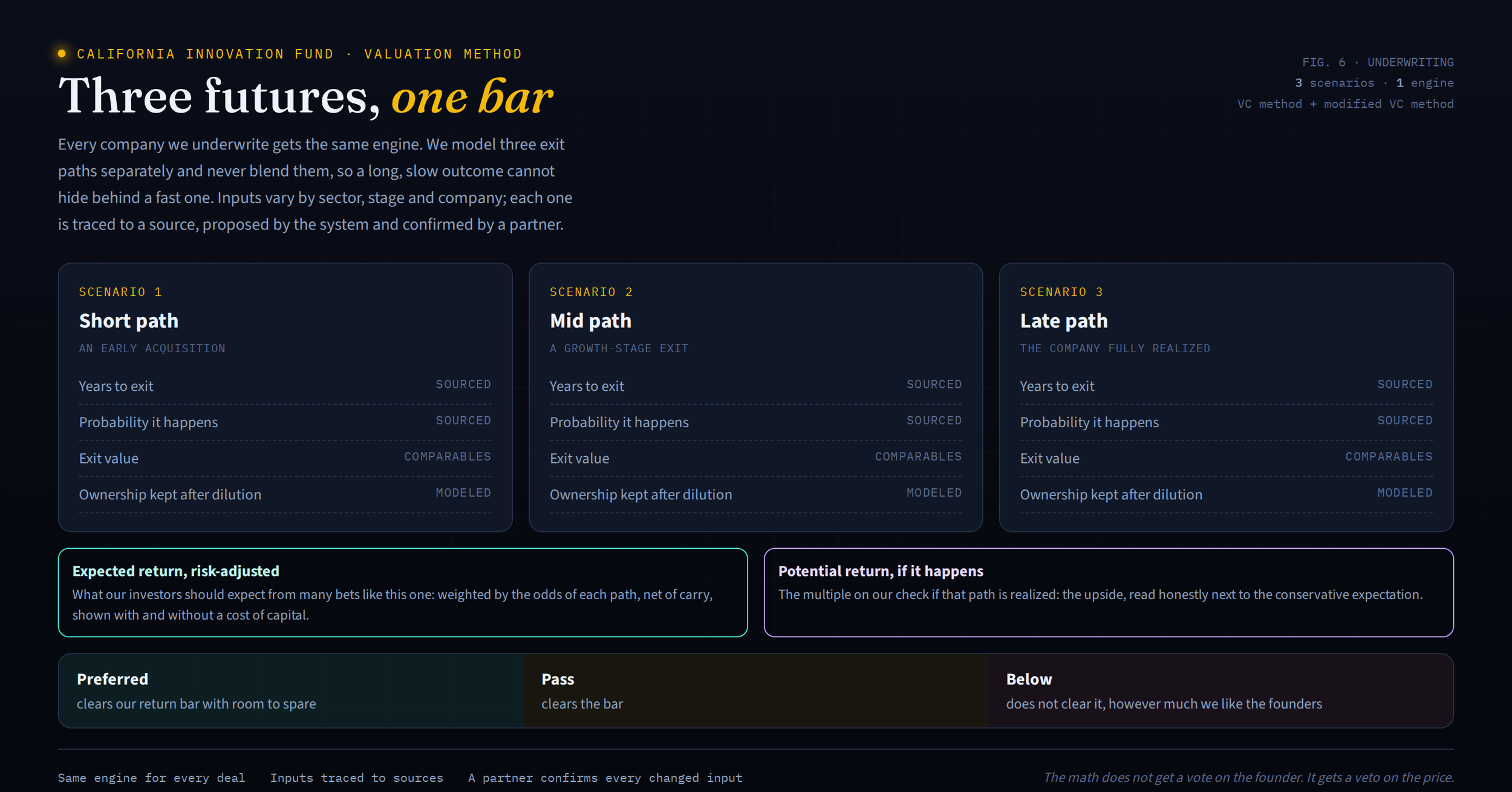
Fig. 6. Three futures, one bar. Every company we underwrite runs through the same engine: three exit paths modeled separately, every input traced to a source, and a return bar the deal has to clear.
Plan your entry, plan your exit. As a trader and an investor, these are critical to think about. Venture layers them even more.
The pre-mortem assumes the company is dead five years from now, writes the most likely chain of events that got it there. It does this by attacking the bull case’s assumptions. Its standard is written into its instructions: if it could not plausibly kill a deal we like, it is not done. We are optimists by temperament - the pragmatic optimist.
From here we can invest with eyes wide open and more rocks overturned than we could have previously thought about. This is all built off of a deep dive structure we created for our fund - but now largely automated. Our own proprietary methods were largely developed by award winning Professor Kurt Beyer and Anne Greul, also a brilliant professor.
We are also adding a second kind of judgment. Kurt Beyer, our co-GP and founder, has taught entrepreneurship at UC Berkeley for more than fifteen years. Every company that reaches deep dive, and every portfolio company each quarter and before any board meeting or formal check-in, will get Kurt's review.
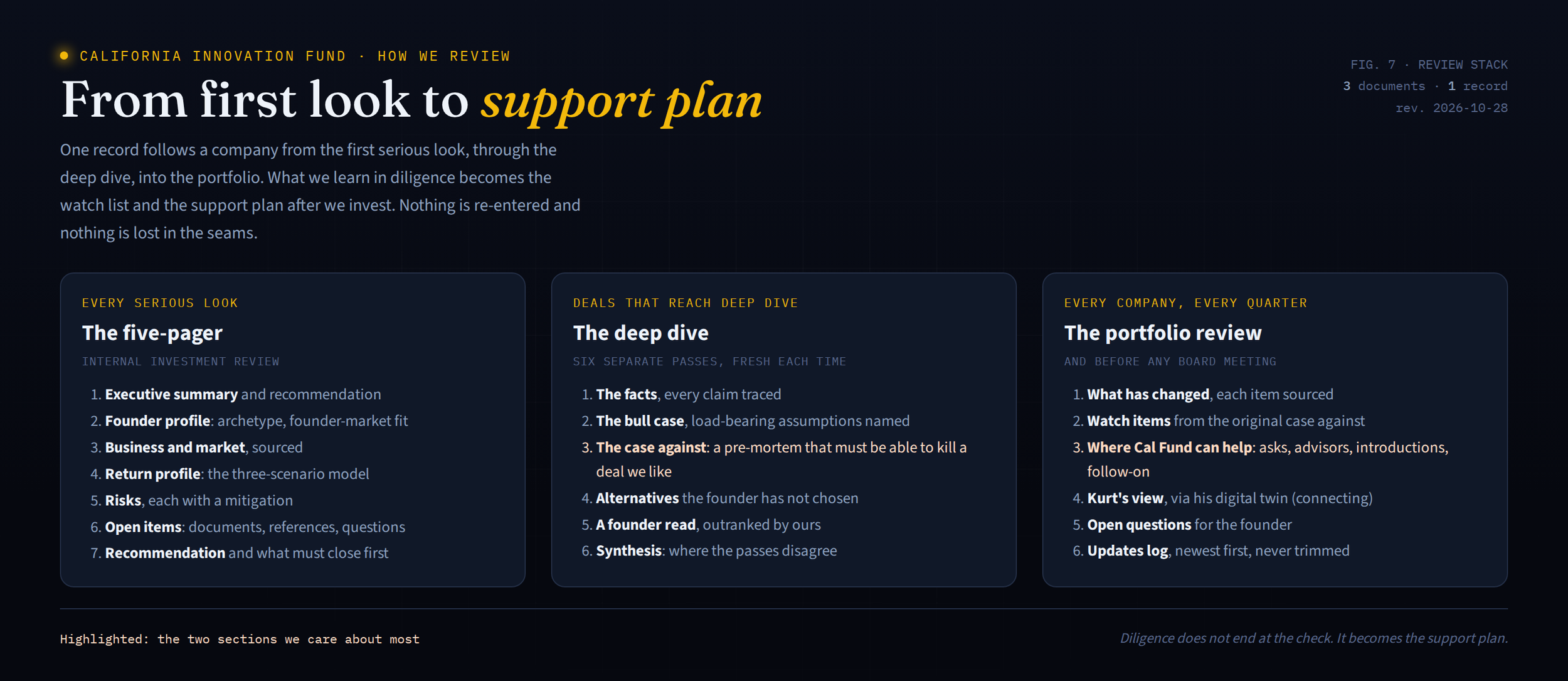
Fig. 7. From first look to support plan. The five-pager, the deep dive and the quarterly portfolio review share one record, so what we learn in diligence becomes the watch list and the support plan.
This way the fund learns about us, learns our methods, and continues to get smarter week after week. Just like us.
Continuous improvement.
Time saved, an estimate
We still have no timed "before," so we will not claim a measured hours figure. What we have is measured volume. Below is an estimate with its assumptions visible, so readers can argue with the assumptions.
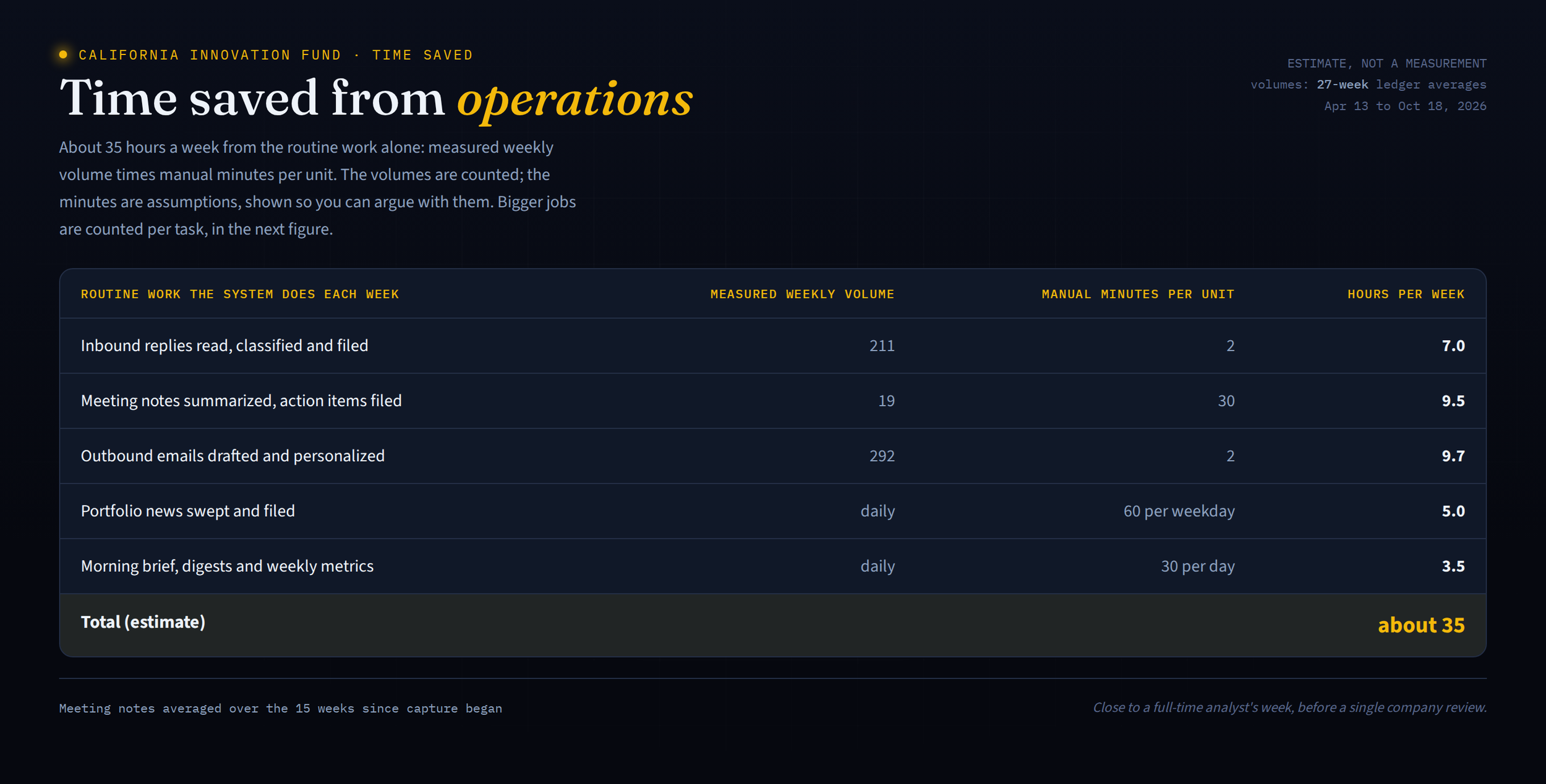
Volumes are ledger averages over the 27 weeks (meeting notes over the 15 weeks since capture began). The minutes are assumptions, not measurements, and deliberately low: one minute per email, two hours per scenario model. On those assumptions the system returns roughly 21 hours a week, more than half the working time of a full-time analyst. We will replace this table when we have a timed measurement.
We also look at a per task, this is where things can really amplify.
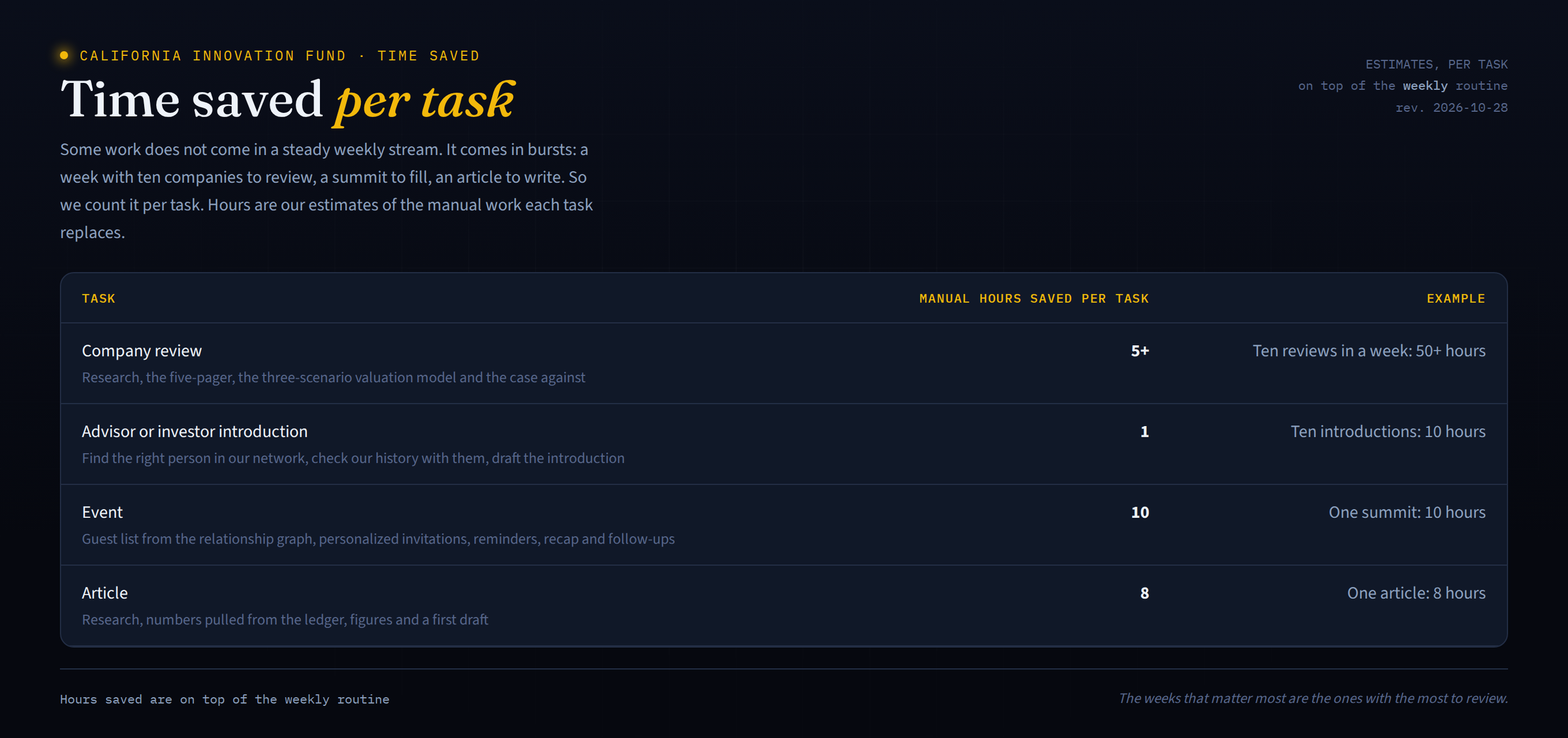
The reviews are an incredible thing. And what if you could simultaneously review and then compare five different companies of similar types? Now we can, in minutes. Over and over, acoss various sectors and stages. This allows for compounding benefits of review. Then we can find who else to contact, what else to dig into, and do a review that would have taken weeks, in days.
What it costs
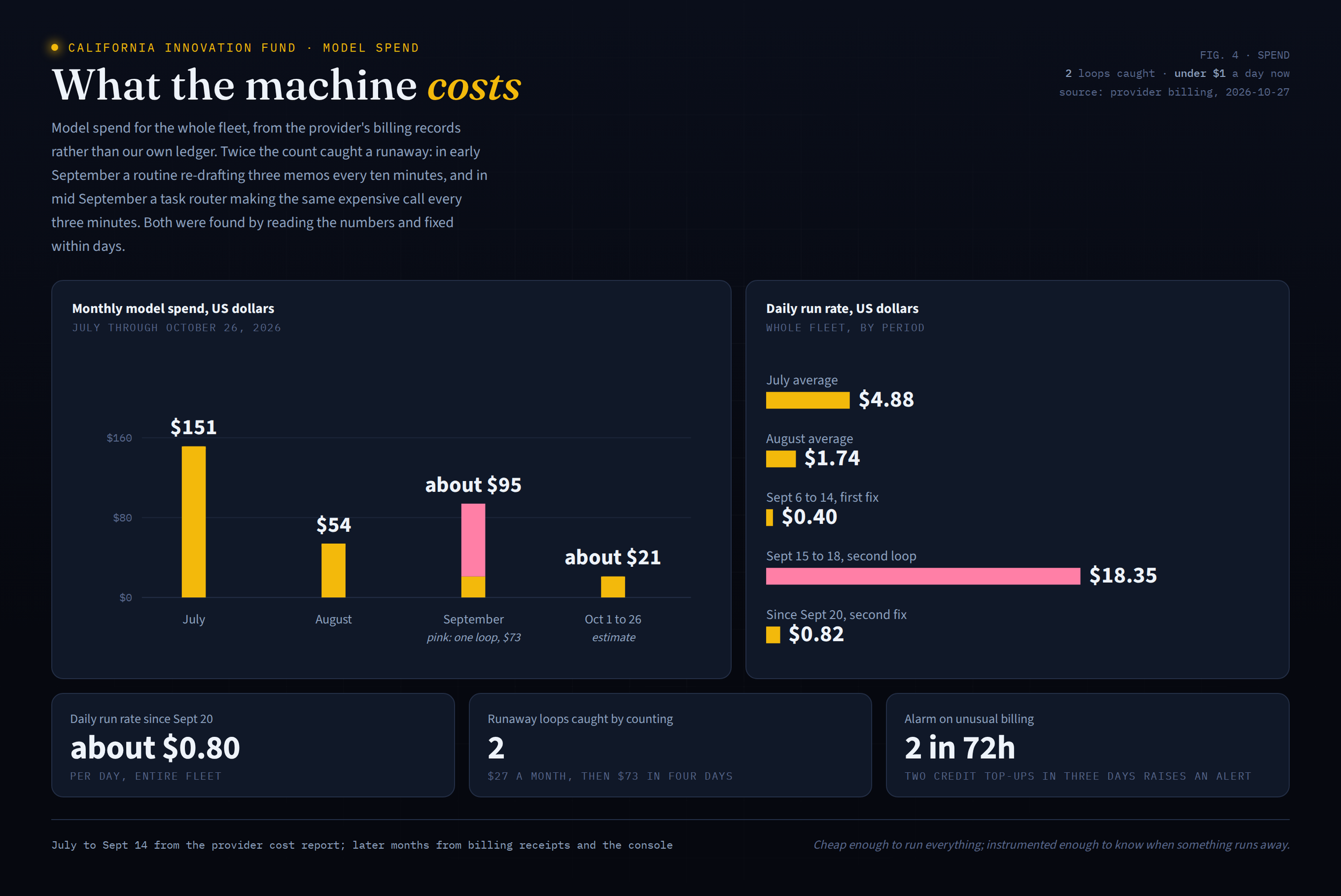
Fig. 4. Model spend for the whole fleet from the provider's billing records, and the daily run rate by period. Pulled October 27, 2026.
Model spend for the whole fleet was $151 in July and $54 in August - this is incremental on top of a max plan. September came to about $95, and about $73 of that was one mistake - you have to admit when there are mistakes, and sometimes a simple programming slip spins a loop - this is why our audit agent is so critical. Since September 20 the fleet has run at about 80 cents a day, roughly $21 for October through the 26th. This doesn’t include company deep dives. We won’t say specifically those costs but I can say a cup of coffee may be more expensive - it’s shocking.
Both drops came from counting. In early September the ledger showed one routine re-drafting the same three portfolio memos every ten minutes, around the clock, because they always came back marked hold: about $27 a month, half the bill. Two weeks later the bill itself jumped, to about $18 a day for four days. A task router was making the same expensive judgment call every three minutes on a handful of tasks it could never resolve. We found it from the billing chart, fixed it so each task is routed once, moved routine work to a smaller model, and added an alarm that fires when the account tops up its credit twice in three days. These were the genesis of our audit agent and tracker. With the new systems you aren’t monitoring every activity regularly, so we have limits set on costs and number of runs to avoid these issues.
Around the model spend sits fixed infrastructure: seven always-on agents for roughly $20 a month, two managed databases, and the software any fund pays for anyway. The operating system as a whole runs in the low hundreds of dollars a month - that’s an hour or two of pay for an employee. This is because we built a deterministic system through programs and agents that run on our own internal systems. It’s, like the whole system, built with intention and purpose.
Cheap enough to run everything. Instrumented enough to know when something runs away.
By the numbers…
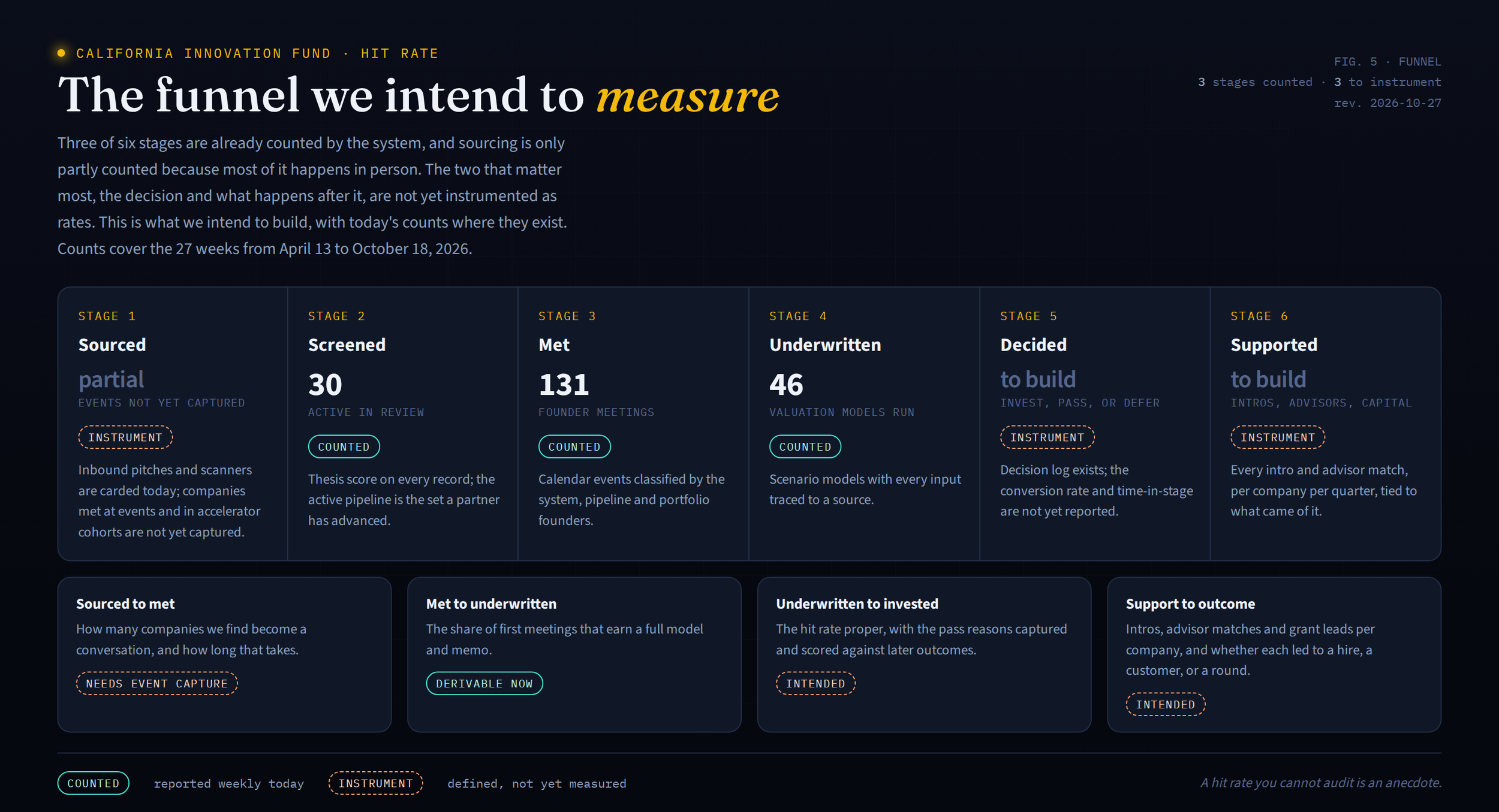
Fig. 5. The funnel we intend to measure. Three stages counted today, sourcing partly counted, two to instrument, and the four rates we intend to report from them. Again, the “Met” number is dramatically lower as many weeks we’ll meet 20-30 founders in person but not move them to active.
While hit rate is an interesting number, quality is more important. That said, our working estimate is that we invest in one to two percent of the companies we review, but that is an estimate, not a rate the ledger reports. Three of the six stages are counted today: screened, met and underwritten. Sourcing is only partly counted, because so much of it happens in person. We aren’t at the point of recording all of our in person interactions - we still respect privacy and permission.
What we intend to add is clear. Conversion at each stage, with time in stage, so we can see where good companies stall, and how we and our system are working collaboratively. A site visit that takes a week or two to schedule, misaligned travel plans, or an expert who is unavailable for a while are all one-off issues, not system issues. It’s life.
Pass reasons captured at the moment of decision and scored against what the company did next, so the funnel shows where our judgment is miscalibrated. And a support-to-outcome record for every portfolio company: each introduction, advisor match and grant lead, and whether it led to a hire, a customer or a round. That last one matters most to us, because it is the measurable form of the promise a fund like ours makes to a founder.
Why we count
Venture is a business of a few consequential decisions surrounded by an enormous amount of ordinary follow-through. The agents make the follow-through reliable. The ledger makes it visible, including when something runs away. Together they let a small fund look at more companies, go deeper on each, support every portfolio company every day, and know, rather than believe, that it is doing so.
We also note that counting everything in a world of outliers is not as helpful. If that one outlier is what makes the fund - then counting every little detail doesn’t seem to make sense. But minding the details is exactly what makes a great founder, a great company, a great team.
Built with intention for purpose
We built this inside the fund, for the fund, by the people who use it every day. Measuring it is part of the mission, not separate from it: it is how we make sure the leverage lands with the founders and the university community we exist to serve. If you’re part of this community and supporting change we are happy to share what we have built and how.
California Innovation Fund invests in University of California founders building amazing companies with passion and enthusiasm. We have a lean towards the deep science from the UC system, but also invest in simply amazing ideas in their early stages. Brilliant founders creating a better planet.
Further reading
From Bryce on Medium: My AI Build: I’m Lovin’ It (and How You Can Too); The Perfect Investor; Portfolio Construction: The Math Never Lies; The Serial Entrepreneur Advantage; The Immigrant Founder Advantage; At the Heart of Purpose: How Impact and Innovation Drive Opportunity; Betting on Berkeley: Alumni Angels; The Chancellor of Innovation.
From the Cal Fund blog: Berkeley’s Flywheel of Innovation; From Classroom to Cal Fund; Cal Fund Highlights #1: What Our Founders Shipped; Yeast Bay Bio Takes Second at the UCLA Draper Innovation Showcase.
Sources upon request, this is not a solicitaiton in any form.
