
Under the Hood is a five-part series on how California Innovation Fund uses AI in the day-to-day work of the fund. In October we gave the wide view in VC in the age of AI. This series takes one system at a time, starting with the one we use most: the review.
The most dangerous person in a diligence meeting is the investor who already likes the company. I know this because I have been that investor. Eager, love what you’re hearing, founder seems incredible. It’s amazing.
That’s when you need to take a step back and take time. That’s why now we take 6-12 months to get to know founders, see how they work, watch them through difficult times, and watch their progress. That’s why being boots on the ground and getting to know people and what they are building early is so important.
At Cal Fund we are optimists by temperament (pragmatic ones, we like to think). Give us a founder with a great story and a lab result that makes the room go quiet, and we can find reasons to say yes. So when we rebuilt our diligence process around AI, we asked it to do two things. Go wider and deeper than a small team can go by hand. And argue with us before we write a check.
This is how that works.
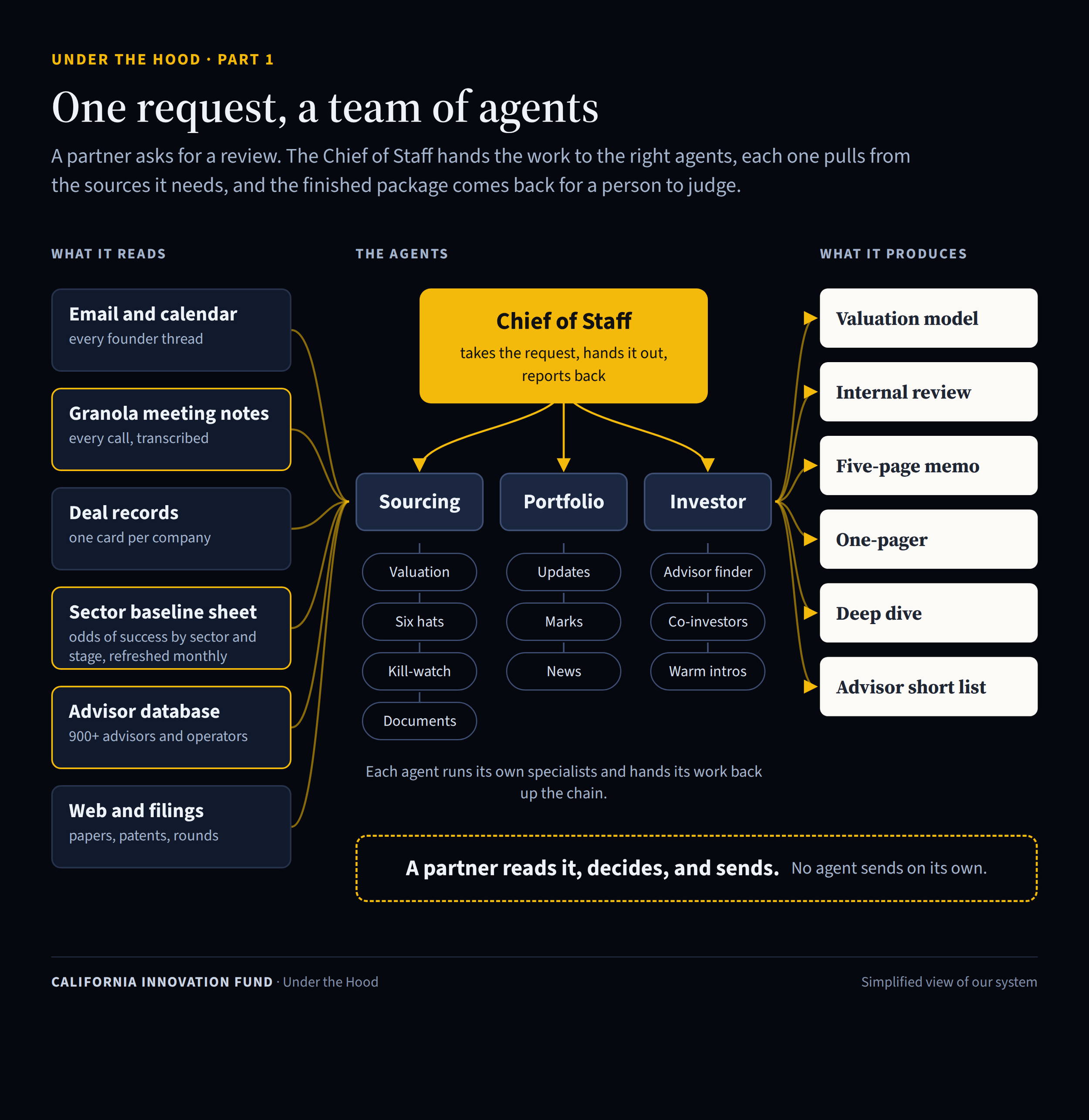
Figure 1. One request, a team of agents. A partner asks for a review, each agent pulls from the sources it needs, and the finished package comes back for a person to judge. (Simplified view of our system.)
Where the review starts
We invest in roughly one to two percent of the companies we review. Much of that filtering happens before even hitting our review process.
Every inbound pitch is screened against our thesis. The one hard gate is a University of California connection, and the system is told that silence is not a no: if a deck does not mention UC, we ask rather than assume. Always a good policy to ask, in real life and diligence.
Stage and round size are never a reason to reject on their own. Clearing the screen is where the real work starts, and that work is where AI has changed the most for us.
One request, a full review package
When a company is worthy of a deeper look, one request to our system starts the build. It reads everything on the company's record (our notes, our meeting history, what the founders have told us since we first met). Phone calls, emails, texts, internet posts, all of it. It highlights our own questions and diligence, and also researches the public record around it. A few minutes later, a full review package lands in the company's folder:
The valuation model. A spreadsheet with two tabs: the math, the similar companies and their exits, and the sources and reasoning behind every input in the math.
The internal review. About five pages, for the partners only. The recommendation, the return picture, the risks, and the part that matters most: open questions, what still needs to be verified, and an action list for the next meeting.
The investment memo. The polished case for co-investors and investors who want the full picture: the opportunity, why we like it, the team, the market, the moat, the return potential and the key risks, stated plainly.
The one-pager. The same case, dense and skimmable. For our LPs, this is the standard view of any company we share.
The deep dive. For companies that keep going, a separate pre-read built to argue with everything above. More on that below.
Done by hand, this was 10 to 20 hours of work per company: market sizing, comparables, three exit scenarios, two memos and a one-pager that all agree with each other. The system turns those 20 hours into a strong first version in about five minutes. We spend the hours we get back on what it cannot do: the second founder call, the reference calls, the expert who has run the same experiment, the site visit. You would want to do this anyways, and now we can go deeper while also going wider.
This also means partners have more energy for deeper reviews. We then couple this with our adviser finder and expert finder tools which let us find, connect with, and get answers from the people who are deeper in these subject areas than us.
More time to go deep while strengthening our network and review. This is Human x AI not just plus.
Evaluating against the right market
The most expensive mistake in a valuation is analyzing a company against the wrong market. Get that wrong and every number downstream is wrong with it, no matter how careful the math.
We learned this the hard way. An early materials company we reviewed makes small-scale energy harvesting for indoor devices. The first pass compared it to utility-scale solar installers. Wrong universe, wrong comparables, wrong exit values.
So before the deep analysis runs, a quick first pass proposes the frame: what the company does in one line, the market it actually competes in, the comparable companies, and its reasoning for each. A partner confirms the frame before anything else is built. When the system is confident, then we just press confirm, a single press of a button. When it is not, it is a real conversation. Showing the reasoning is the point: a bad comparable is usually a symptom of a bad read on the market.
While comparing emerging companies is always looking at something “new” you have to base it in a current or past similar market.
And when you’ve been looking at startups enough you know a true blue ocean opportunity, or a true game changing technology: the comparables may not exist or may need handholding. These preliminary reviews take care of those edge cases as well.
Three futures, one return bar to pass
Our valuation method was built for venture, where the honest answer to “what is this company worth” is “it depends which future happens.”
So the model never produces one future. It builds three exits: a short path, a mid path and a long path. For each one it estimates the probability that the company reaches that stage and sells, the years it takes, how much of our stake survives the dilution of later rounds, and what the company is worth at exit, with comparable companies behind that number.
The estimates follow rules written into the research step:
Probabilities can only fall as the horizon gets longer. Reaching year ten is never more likely than reaching year three. But selling at year ten may be more likely. This all needs to be taken into account.
Real de-risking earns real credit. Significant non-dilutive funding, a lighter regulatory path, or data well ahead of the company's stage all move the odds up.
Dilution follows the calendar. Priced rounds come roughly every eighteen months to two years, so the model counts how many rounds fit before each exit instead of applying one flat haircut. This is sector specific as well; each sector has its own nuances.
Every company starts from a baseline. Partner-confirmed expected success rates for 23 sectors at four stages, adjusted for what we see in UC-sourced companies, with a market reference refreshed every month as a check.
From there the math is pure arithmetic with no AI involved. Each scenario is run two ways, with and without a cost of capital, using both the classic VC method and a modified version that asks the question our LPs actually care about: what does this return to them, after fees and carry? Each scenario then gets a verdict against our bar: below it, passing, or preferred.
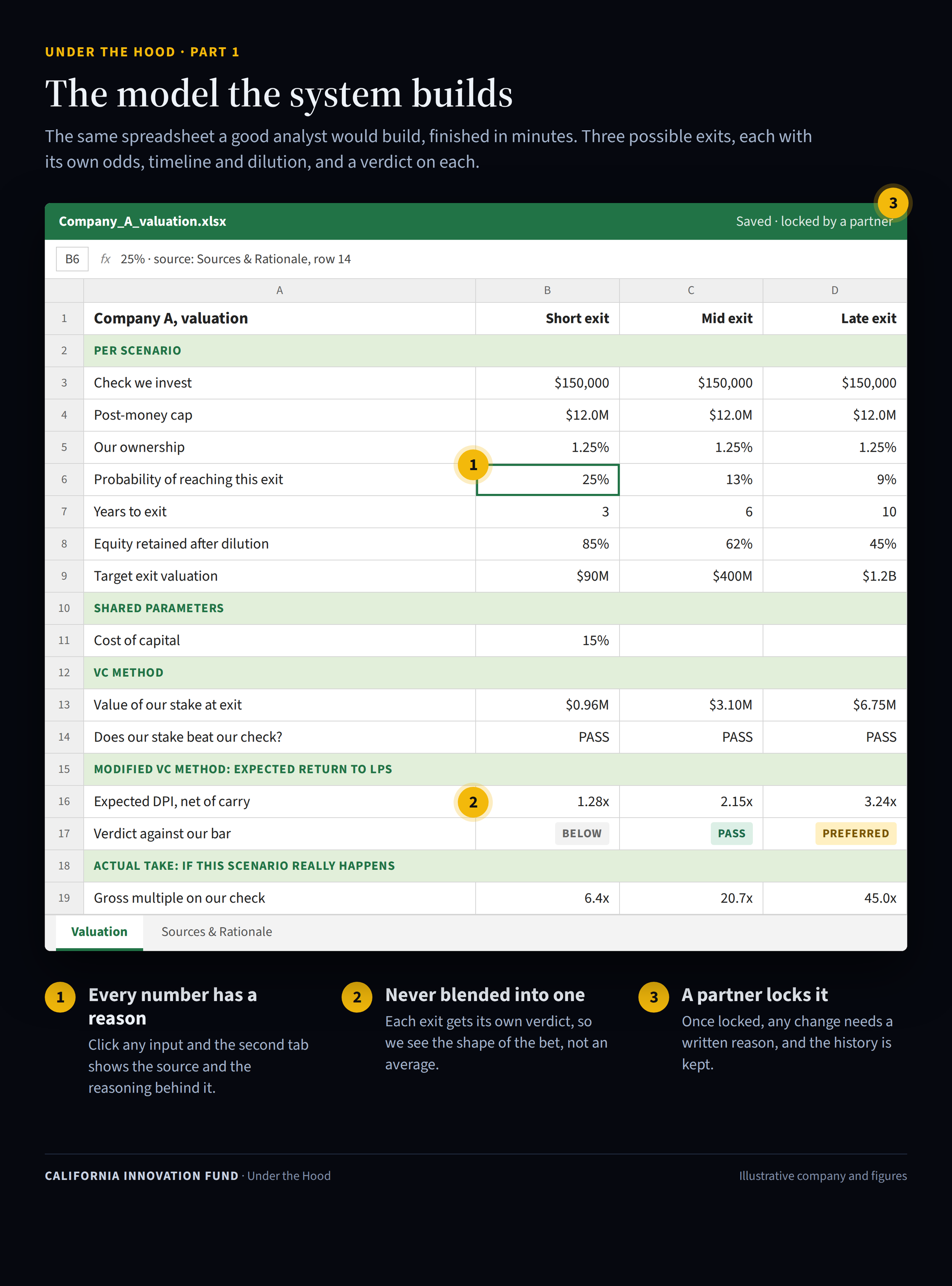
Figure 2. The model the system builds. Three possible exits, each with its own odds, timeline and dilution, and a verdict on each. (Illustrative company and figures.)
We never blend the three into one number. A single blended figure hides the shape of the bet, and the shape is the whole point. Some companies fail the short path and clear the long one by a mile. That is a very different investment from one that looks good in year three and runs but is less of a moon shot. For portfolio management and planning, this matters tremendously.
At the California Innovation Fund we look to find a balance of potential long term and medium term exits, and where possible including companies that could see short term purchases as well. This gives investors the opportunity for earlier returns while maintaining our goal of performing as a top tier fund and giving our investors very high multiple returns.
Then a partner locks it. A valuation becomes official only when a partner confirms the terms of the round and the check. Changing a locked number requires a written reason, and the history is kept, so a year from now we can see exactly what we believed and why. Partners can still run what-ifs in a live copy of the sheet without touching the official number.
Every claim carries its source
The second tab of every model is called Sources and Rationale, and it is the one we are proudest of. Every input on the first tab traces to a reason and a comparable on the second: why this cap, why these odds, why this exit value, how confident we are in the comparable set, and what still needs a human look. If the sources are missing for any reason, the tab does not quietly go blank. It says so in large letters.
The memos follow the same discipline. Every fact is labeled by how we know it: confirmed by us first-hand, stated by the founder and not yet corroborated, or found in public and not yet verified. A founder's number is never repeated as fact until we have checked it. And when founders correct something we wrote, the correction goes onto the company's record, so the next version of the memo carries their facts, not our old draft. Verified and confirmed by a partner.
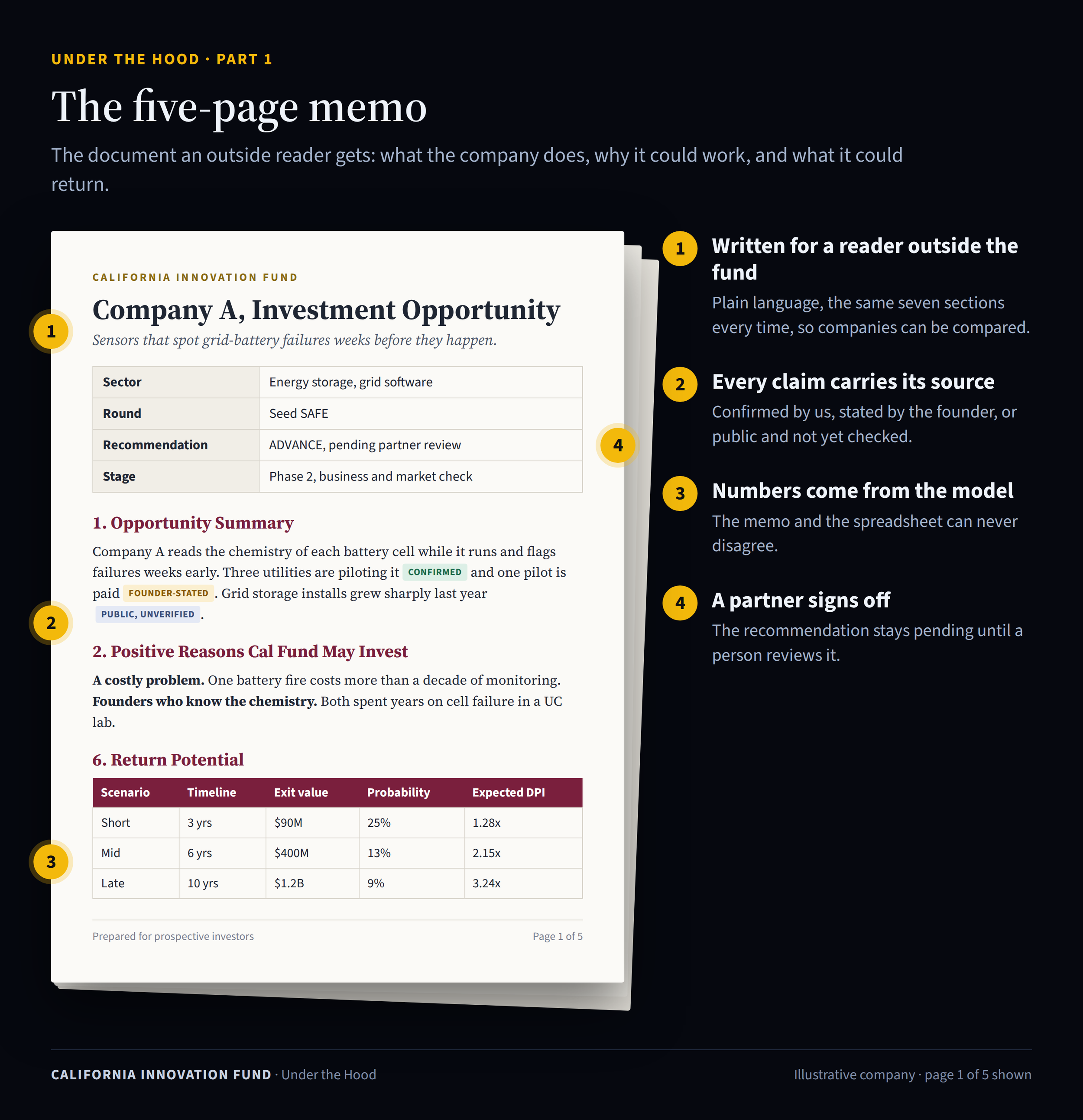
Figure 3. Page one of the five-page memo. Every claim carries its source, and the return table comes straight from the model. (Illustrative company.)
Some fields the system will not fill at all. Coachability, founder conviction, how the team handles pressure, what references said: those come from people. Where a memo needs one, it leaves a marked placeholder for a partner to complete. It will not invent a qualitative read on a human being.
The deep dive
The package above makes the case. The deep dive's job is to test it.
From the package a company moves through financial diligence with Jerry Bellman, our Managing Partner who reviews the numbers on every deal. Then comes the deep dive, and after that the partner meeting where we decide.
The deep dive is a pre-read for that meeting. It does not decide anything. Scenario probabilities, gut ratings, terms and the final call belong to the partners, and the system is written so it cannot take them. The structure itself is not new. Professor Kurt Beyer, our founder, and Anne Greul built the deep dive method we ran by hand for years. What changed is that it now runs in full on every company that gets this far, not just on the ones we had time for. It also lets us do multiple companies and cross compare in the time it would take to grab a coffee.
It runs in five stages, always in the same order. It consolidates everything we know into a gaps table (what we still do not know) and a claims ledger (what the company told us against what we have verified). It writes the questions: written ones for the founders, sent by a partner as an email, five ranked questions for the live meeting, and internal questions routed to the person on our team who owns each one. It re-checks the valuation mechanically. Then come the hats.
Six hats
If you have spent time in a business school classroom you have probably met Edward de Bono's Six Thinking Hats on a whiteboard. The idea is simple: look at the same problem one way at a time, so optimism and fear do not talk over each other. We borrowed it because it works, and because AI turns out to be very good at wearing one hat at a time. We feel it gives us another edge.
Each hat runs as its own separate pass with a fresh start. The optimist never sees the skeptic's notes, and the gut read is not colored by the spreadsheet.
White, the facts. The ten facts that matter most, which claims are still unverified, and the five missing facts we most need.
Yellow, the bull case. The best realistic sequence of events, plus the three load-bearing assumptions holding that case up. Naming them is the point. If the bull case cannot say what it stands on, it is a mood rather than an argument.
Black, the pre-mortem. Assume the company is dead five years from now. Write the most likely chain of events that got it there. Then name the three risks most likely to kill it, with the early warning sign for each, and check the deal against the patterns from our own past losses.
Green, the alternatives. Three other paths the company could take, a second use for what it is building, ideas for how the deal could be structured, and where it might help other companies we have backed.
Red, the gut. Half a page, no more. A read on the founders, a line asking whether a known bias is doing the talking, and then it asks the partners for our own gut reads before we look at its.
Blue, the synthesis. The last pass is told not to add analysis. It maps where the hats disagree, writes the one-sentence crux of the decision, fills in a scorecard (thesis fit, founder, market, financials, risk) and recommends one of five outcomes: invest, invest with conditions, support the company through our community, watchlist, or pass. It also writes the agenda for the partner meeting.
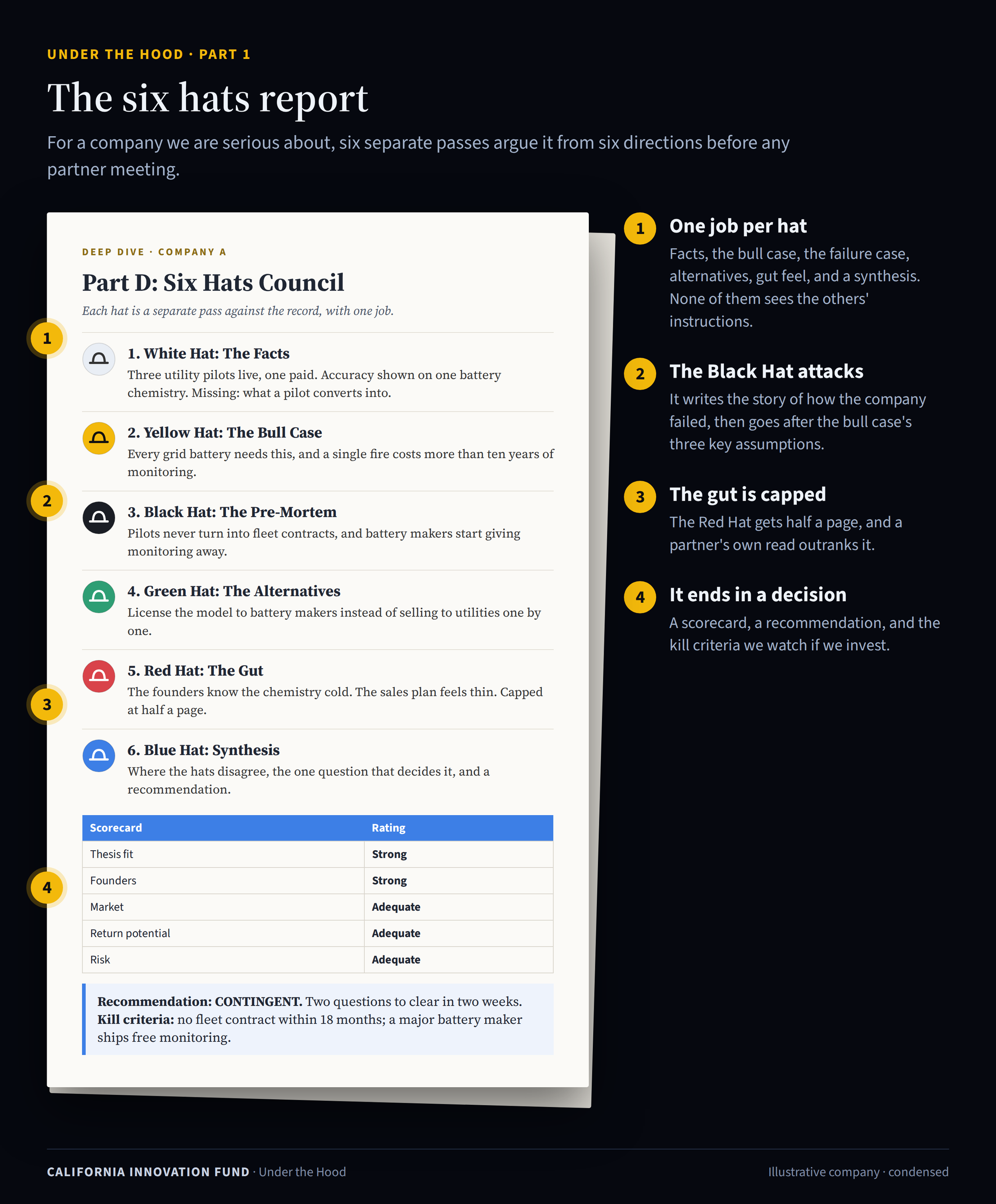
Figure 4. The six hats report. Six separate passes argue the company from six directions, then a scorecard, a recommendation and the kill criteria. (Illustrative company, condensed.)
The counter-case
The Black Hat is the one other investors ask about.
It is the only hat that sees another hat's output. It receives the Yellow Hat's three load-bearing assumptions and attacks each one directly. It runs on the strongest model we use. And its standard is written into its instructions: find every reason you can to not do this deal.
It also has a seat at the table. In the partner meeting, someone has to speak for the Black Hat memo so we maintain a balanced perspective of pros and cons. Even when everyone in the room likes the founder (which is often, our founders are great) the bear case still gets heard.
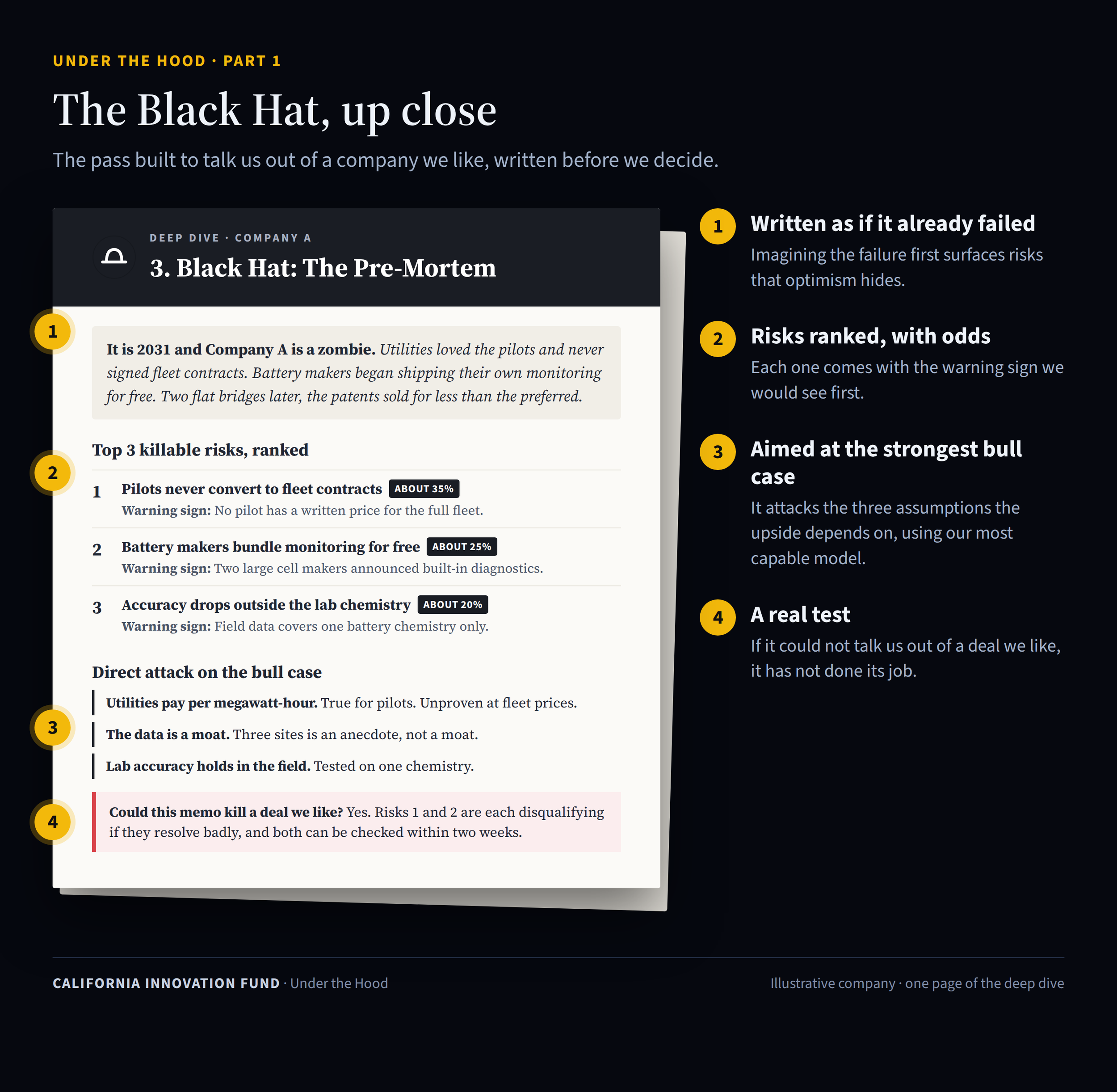
Figure 5. The Black Hat, up close. The failure story, three ranked risks with odds and warning signs, and a direct attack on the bull case. (Illustrative company.)
I did not build this because I am unusually disciplined. I built it because the best investors I know all have a partner whose job is to say “wait.” Now every deal gets one.
The deep dive also stays on evidence we can trace. It does not browse the web during the hats; web research happens earlier, in the review package, where every outside claim carries a label. It reasons over what we have filed: the company record and its full history of notes, the locked valuation model, the list of documents in the company's folder, and our own library of patterns from past wins and losses. So every sentence in it can be checked.
What it changes
Speed is the obvious change, and it is real. The less obvious one matters more. When a full review costs minutes instead of days, we run it on companies we might once have set aside for lack of time rather than lack of merit. Some of those turn out to be very interesting.
It also changes the conversation with founders. The questions we bring to a second meeting are sharper, because the gaps table already told us what we do not know.
Kill criteria: the part that keeps running after we invest
The synthesis writes two to four kill criteria for every company: observable events that would mean our thesis is broken. They are specific on purpose. Think “the paid pilot with the lead customer does not convert within twelve months” rather than “execution risk.”
Those criteria are saved with the company, and an AI agent checks them about every six hours. It looks only at what is new since its last look: news about the company, round announcements, notes from our meetings, and changes to the company record. If nothing is new, it does nothing and costs nothing, which is most of the time. If something new plainly matches a criterion, a partner gets an alert with the criterion, the evidence, and a one-line read, plus two choices: run the Black Hat again with the new facts, or stand the alert down. Nothing is decided, moved or sent on its own.
Most investors write a bear case once, at the time of investment, and never read it again. Ours checks itself four times a day.
Where this goes next
A good review produces better questions, and some of those questions can only be answered by someone outside the fund: a regulatory specialist, a scientist who has run the same experiment, an operator who has sold into the same customer. That is the job of our advisor finder tool, which searches the advisors and operators we actually know for the person who has done this before. That is Part 2, in January.
In February, Part 3 turns the lens on ourselves: what happened to the companies we passed on, and how we grade the deep dive against what actually happened.
And all of it rests on a complete record. Every meeting, every founder update, every promised follow-up lands in our integrated backend CRM system, built so we never skip a note. That gets its own article in March.
If you are a founder who has been through one of our reviews and wondered why the questions were so specific, now you know. The Black Hat sends its regards.
Under the Hood: Part 1, the review (this article). Part 2, the advisor finder (January). Part 3, keeping score on the ones we passed (February). Part 4, the CRM that never skips a note (March). Part 5, why our agents never hit send (April). Start with the overview: VC in the age of AI. For the personal side of the build, see My AI Build on Medium.
This article describes our internal process. It is not an offer to sell or a solicitation of an offer to buy any security.
